May 29, 2009

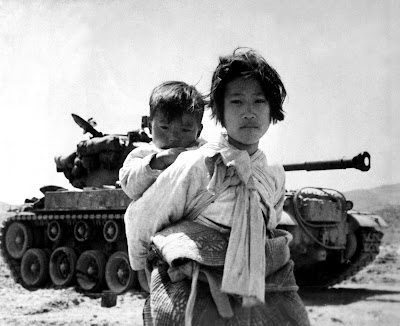
North and South Korea on verge of open war

POLITICS - North Korea test-fired another short-range missile today, the sixth in the last week and warned it would act in "self-defence" if provoked. The recent nuclear test on Monday by North Korea suggests Koreans (both North and South) should be worried about impending invasions.

Today's missile tested has a range of approx. 260 km, which would give it enough range to reach most of South Korea's cities, but not Pusan, a military headquarters. However North Korea test fired a long range missile in April, one capable of reaching Hawaii.

Chinese and Japanese fishing boats have left the region and South Korean and American forces are now on high alert. U.S. Secretary of Defense Robert Gates said the situation is not yet a crisis and no additional U.S. troops would be sent to the region, but he didn't rule out the possibility.

North Korea accused the United Nations Security Council of hypocrisy is a released statement. "There is a limit to our patience," the statement said. "The nuclear test conducted in our nation this time is the Earth's 2,054th nuclear test. The five permanent members of the UN Security Council have conducted 99.99 per cent of the total nuclear tests."

North Korea insists it will only act in defense. Fears of a skirmish could set off an escalation towards war.

The North has renounced the truce that has kept peace between the two Koreas since the Korean War ended in 1953. The waters off the west coast were the site of two deadly skirmishes in 1999 and 2002.

"For now, it seems quiet," said South Korean construction worker Lee Hae-un, 43. "But if North Korea provokes us with military power, I think our government should actively and firmly counteract it."

The United States has 28,000 American troops stationed in South Korea.

North Korea meanwhile has 1.2-million troops and is one of the world's largest. A war with North Korea may require the United States to draft additional troops and would destabilize global politics, as Iran and other countries may decide to take advantage of the situation.

The two Koreas technically remain at war because they signed a truce in 1953, not a peace treaty.

May 26, 2009

The Return of Hundred Dollar Oil

POLITICS - Its back. Can't you smell it? People are burning through gasoline again faster than you can say "Fill'er'up".

Last summer the summer driving season (beach parties, long weekends, vacations at the summer cottage, visiting friends and relatives) was so intense it drove oil prices up to a record $147.27 USD.

We had predicted Hundred Dollar Oil would come, especially with the world's easily accessible oil supplies dwindling and we're now so desperate we are going to tar (ie. the Alberta Oil Sands) and even coal (China is converting coal into gasoline) in order to fuel our cars when supply becomes low.

The shortage is most noticeable in the United States, which according to a 2007 CIA estimate consumes 20.68 million barrels of oil per day (almost one quarter or the world's total oil consumption, see the CIA World Factbook for more details).

After last summer's driving season was finally over, prices settled back down below the hundred dollar mark and even reached $35 USD earlier this year... but with the prospect of another driving season up ahead the prices have already shot up to $62 USD and many industry analysts are predicting the return of hundred dollar oil.

"The stage is currently being set for oil prices to skyrocket," says U.S. energy analyst David Fessler. Fessler cites the decline of such super fields as the North Sea, Alaska's North Slope, Mexico's Cantrell Field and Saudi Arabia's Ghawar Field – largest in the world – along with the extraordinary cost of producing crude from the few remaining newer crude sources such as Alberta's Athabasca tarsands and reserves six or seven kilometres below sea level off the coast of Brazil as signs that we are facing another oil shortage and skyrocketing prices.

"If demand in China and elsewhere returns to its previous rate of growth, it will not be too long before the same calculus that produced the oil-price spike of 2007-08 will be back to haunt us again," says economics professor James Hamilton of the University of California at San Diego. He and several others are predicting Two Hundred Dollar Oil by 2014. Maybe sooner.

"You're going to be back to $75 (U.S.) oil by the end of the year, and $200 (USD) per barrel within five years." says ex-oil tycoon T. Boone Pickens, now a champion of alternative energy.

It doesn't help that the oil industry has cut funding for oil exploration. Despite record profits, the industry isn't looking for new oil sources as much as it usually does, perhaps realizing its more profitable to drum up more money by playing into the doom-and-gloom of the growing shortage.

When oil collapsed more than 70 per cent from its July 2008 record high, many major oil firms slashed their exploration budgets claiming the lower prices did not cover the expenses of today's high-cost of finding new sources. High cost? Pfff. Utter nonsense. Their record profits tells a different story.

The Organization of Petroleum Exporting Countries (OPEC), has delayed 35 new exploration projects until 2013. About $100 billion USD worth of Alberta tarsands expansion projects are now on hold. Civil war continues to rage in Nigeria, America's fifth-largest source of oil imports and a source of frequent supply disruptions.

And when the global recession ends, demand in China, India and other growing economies will come back strong, and thus will push oil prices up faster and farther than ever expected. With the lack of new exploration it means we may finally meet the peak oil pinnacle.

(Peak Oil is the theory wherein oil demand finally out paces supply, creating on a graph a peak between declining oil supply and growing demand. After that point its guaranteed oil prices will skyrocket.)

To combat that eventuality many nations and the automotive industry are pushing the idea of cars that run on alternative energy, such as hydrogen (gasoline is many of hydrogen and carbon) and is actually a more efficient energy source, but North America currently lacks the infrastructure to distribute it. It would take several years to build the infrastructure required.

If we see $100+ oil again, perhaps permanently, we could see public opinion swayed to the point where hydrogen-distribution infrastructure is suddenly on the public agenda.

North Korea tests nuke, launches two missiles

POLITICS - Communist nation North Korea tested two more short-range missiles Tuesday, one day after its nuclear weapon test.

Pyongyang also warned ships to stay away from waters off its western coast this week, a sign the country may be gearing up for more missile tests. South Korea's coast guard says they will be maintaining their distance but keeping a watch out for more test missiles.

Yesterday North Korea conducted an underground atomic test in the northeast that the UN Security Council condemned as a "clear violation" of a 2006 resolution banning North Korea from developing its nuclear program.

The 2006 resolution apparently fell on deaf ears in North Korea, the so-called "Hermit Kingdom" because it rarely trades with other nations and has essentially cut itself off from the outside world.

The United States and Japan are pushing for strong action against North Korea for testing a bomb that Russian officials said was comparable in power to those that obliterated Hiroshima and Nagasaki during World War II.

Russia, once a key backer of North Korea, condemned the test and is also urging to punish North Korea through diplomatic sanctions, although many question how well sanctions work in a country that refuses to trade with outsiders and doesn't acknowledge the authority of the United Nations Security Council.

North Korea's test of a long-range missile in July 2006 and its first nuclear test in October 2006 (see North Korea's Nuclear Test - October 9th, 2006)drew stiff sanctions from the Security Council and orders to refrain from engaging in ballistic missile-related activity and to stop developing its nuclear program. Demands which were basically ignored.

Last month North Korea went ahead and launched a long-range rocket on April 5th. The rocket was a failure, but its goal was to reach the California coastal waters a mere stone's throw from the United States. It splashed down north of Hawaii instead.

Meanwhile South Korea (North Korea's enemy for over 50 years) announced today it would join a maritime web of more than 90 countries that intercept ships suspected of spreading weapons of mass destruction, a move North Korea warned would constitute an act of war if any North Korean ships are intercepted.

South Korea's capitol Seoul is mere miles from the DMZ between the two Korean nations and has 24.5 million people living in its metropolitan area. Its believed a nuclear war with North Korea would make Seoul the first target. Pusan, the second largest city and a military HQ, would be the second most likely target.

Kim Jong Il, North Korea's "Great Leader", had a stroke in 2008 (see North Korean Dictator suffers stroke) and has become increasingly erratic in his behaviour and aggression towards the USA.

May 19, 2009

Women more vulnerable to lung damage

HEALTH - Women may be more vulnerable to lung damage from smoking than men, according to new research.

In a study looking at chronic obstructive pulmonary disease (COPD), scientists at Brigham and Women's Hospital, part of Harvard University Medical School, and the University of Bergen in Norway found that female smokers experienced reduced lung function at a lower level of exposure and at a younger age than male smokers.

"There's an important public health message here," says senior author Dr. Dawn DeMeo, assistant professor of medicine at Harvard. "Many women believe their smoking is too limited to be harmful, that a few cigarettes a day is a minimal risk. Our research shows there's no safe amount, especially for women."

The study, presented yesterday at the American Thoracic Society conference in San Diego, analyzed data from Norway of current and former smokers, 954 of whom had COPD; 955 were controls.

The gender differences were most pronounced among COPD patients under the age of 60, considered early onset, and those who smoked less than a pack a day for 20 years, the low-exposure group.

COPD is a progressive disease characterized by increasingly difficult breathing. It is most often caused by cigarette smoking and includes the conditions emphysema and chronic bronchitis

Another study, also reported this month, looked at 683 lung cancer patients at a Swiss treatment centre. It found that women tended to be younger when they got cancer even though, on average, they had smoked less than the men, suggesting an increased susceptibility.

The findings were presented earlier this month at the European Multidisciplinary Conference in Thoracic Oncology in Switzerland.

Previous research has also indicated an increased female vulnerability. "The idea has been around for 10 to 15 years. The evidence is building up piece by piece," says Dr. Donna Stewart, chair of women's health at the University Health Network, in Toronto.

But no one knows why there might be a gender difference.

"One theory is that women have smaller lungs than men, so each cigarette does more harm," says Dr. Inga-Cecilie Soerheim, lead author on the COPD study.

Another possible explanation is that men and women metabolize cigarette smoke differently. An enzyme involved in metabolizing drugs and tobacco smoke is regulated by estrogen, Stewart explains. Genetic factors may also be at play.

Roberta Ferrence, executive director of the Ontario Tobacco Research Unit, is cautious about putting too much emphasis on gender differences.

"It's very difficult to figure out what's biological, genetic, environmental, behavioural. Even the type of cigarette and how it's smoked is part of it," she says.

"It's a complex mix. The bottom line is that everyone should quit and nobody should start," adds Ferrence.

In Canada, lung cancer is the leading cause of cancer death for both men and women.

Affordable Website Design & SEO

Looking for a quality professional website designer? Why not go where the smart money is?! Toronto Website Design and Toronto SEO. Get free SEO advice from people who really know the business.

Featured Posts

The Sarcasm Symbol
Ever had some confusion online or with your cellphone when someone fails to catch the sarcasm? Well now with the SarcMark you can ge...
Behold, the Scorpion Hydrogen Supercar
CARS - To the right is the future of supercars... it is a hydrogen supercar called the Scorpion. The Scorpion from Ronn Motors in Texas is t...
Documents show Stephen Harper misusing public funds
CANADA - According to 950+ pages of documents obtained by the Canadian Press under the Access to Information Act the Privy Coun...
Pink's Rosie the Riveter
ENTERTAINMENT - What I like about this video is how it meshes different social movements like feminism, veganism, anti-capitalism...
California's Dustbowl
ENVIRONMENT - The photo on the right is a farm in California that has been put up for sale. Its just one of thousands of farms that are n...
Is Steampunk the New Goth???
GOTHIC - Watch out what you see on the subway late at night because while in 2001 you might have seen some pretty freakish goths, by 20...
Do you have enough Ice Water in your diet?
HEALTH - A Calorie (large C) is a measurement of the amount of energy needed to raise the temperature of a litre of water (1 kg's worth) ...
North Korean timeline towards Inevitable War
POLITICS - The following is timeline of events that have occurred on the Korean Peninsula. 1945 - Japan surrenders to the United States a...
Judgment Day is Tomorrow, so sayeth Cult
RELIGION - According to a cult based in California, Judgement Day is tomorrow (May 21st 2011) and Jesus Christ will return to the Earth a...
Sex in Space Forbidden
SEX/TECHNOLOGY - Sex in outer space is a big no-no according to NASA. Not for professional astronauts at least, but the growing numb...

Popular Posts / Last 30 Days